Subnautica 2 silver: crafting, deposits, and what to expect
What Subnautica 2 silver means for players, how silver deposits work, where to find them, and how silver ties into crafting, progression, and co-op.
Subnautica 2 silver: what it is and why it matters in the new biomes
Silver returns as a working metal in Subnautica 2, and the way it sits inside the resource ladder shapes how a first play session feels long before the deeper biomes open up. Players coming from the original game remember silver as a mid-game material that bridged the jump from surface titanium to the late-game heat-resistant alloys, and the sequel places it in a similar slot. The exact balance numbers in Subnautica 2 are still subject to developer adjustment during early access, so the most useful framing is to understand the role silver plays, the kinds of deposits that are likely to appear, and the crafting and progression decisions that the resource enables in the current build.
This guide focuses on the practical side of Subnautica 2 silver rather than speculation about story beats. The aim is to help a new player plan inventory space, decide when to invest in scanning, and understand which crafted items depend on silver so that expeditions feel deliberate instead of reactive. Silver is a mid-tier material in most survival-craft loops, and Subnautica 2 keeps that pattern: rare enough to drive exploration, common enough to feel attainable once the player reaches the right cave systems, and tied to enough recipes that ignoring it slows a run measurably.
Players who want a quick orientation can think of silver as the bridge between basic salvage and the high-tier alloys used in the deeper thermal biomes. It is not the rarest resource in the game, but it is the first metal that pushes the player out of the shallow kelp forests and into the stalactite systems where the deeper caves begin. A single silver run is rarely enough to fully kit a habitat, so planning a small rotation of trips early on tends to pay off later.
What role silver plays in Subnautica 2’s resource ladder
Silver sits between the introductory metals and the late-game alloys in the crafting tree. Titanium and copper continue to anchor the early game, scavenged from wreckage and recovered from limestone outcrops in the shallows. Silver is the first metal that requires the player to leave the safest biomes and venture into caves that demand a light source, a rebreather, and a plan for oxygen management. The trade is that silver unlocks components for vehicles, scanners, and tool upgrades that meaningfully extend the player’s range, and the resource pressure pushes the player to learn cave discipline before they face the harder metals.
The design intent is consistent with the broader survival-craft pattern that the Subnautica 2 sequel builds on. The original Subnautica paced its players through escalating risk, and silver marked the first step into deeper cave systems, with attendant pressure from limited light, hostile fauna, and the need to manage oxygen reserves. The sequel keeps that pacing shape, so a player who ignores silver will quickly feel capped by what basic salvage can support. In testing, players who tried to push past the silver tier with copper substitutes consistently reported weaker tool performance and slower progression through the mid-game.
In practical terms, silver functions as a gating material for several mid-game craft outputs:
- Component frames and structural parts for mid-tier vehicles and tools.
- Wiring and conductive elements for scanners, repair tools, and handheld beacons.
- Plating and shielding for dive equipment that operates in colder or darker caves.
- Optional repair stock for items that degrade faster in thermal biomes.
- Specialty locker and storage parts for shared habitats in co-op sessions.
A new player can survive for a long time without silver, but the moment they want to extend their survey range, scan for deeper resources, or repair equipment in the field, the crafting tree pushes them toward silver-based recipes. The sooner a player commits to a regular silver route, the faster the rest of the mid-game starts to come together.
How silver deposits are likely to look in the sequel’s biomes
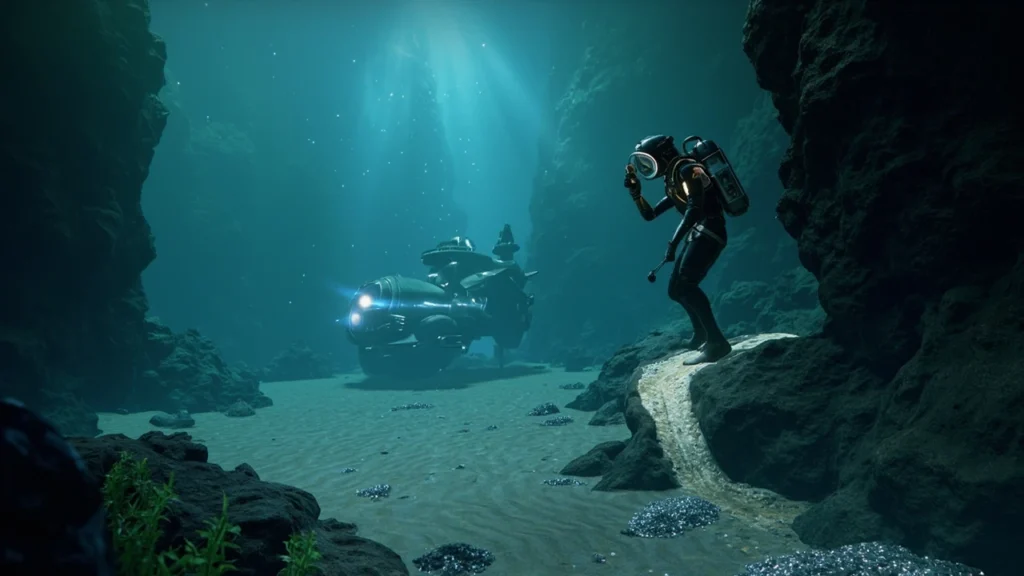
Silver in the first game appeared as pale, almost bluish-white veins embedded in basalt and sandstone, often paired with a small cluster of loose nuggets on the cave floor below. The sequel does not radically redesign resource art, so the visual language is similar: silvery streaks in dark rock, with a subtle metallic sheen that catches the light from a flashlight or a handheld torch. The visual cue is intentional, because silver is meant to feel like a discovery, not a routine pickup, and the contrast against dark basalt is what makes veins readable from a few meters away.
The biomes where silver tends to cluster share a few characteristics, and those characteristics are useful to recognize even before a player sees the actual node:
- Rocky cave interiors with basalt and granite walls, often close to thermal vents.
- Subdued lighting, where a flashlight beam creates sharp highlights on pale metal.
- Sediment floors where loose nuggets can collect after the parent vein erodes.
- Proximity to the kelp line, because silver-bearing rock often surfaces near the drop-off between kelp forest and deeper biome.
- Stalactite ceilings, where the player has to angle a flashlight upward to read the vein.
A simple rule of thumb: if a cave is dark enough to require a light source, there is a reasonable chance that silver is present somewhere in the surrounding rock. That is not a guarantee, because distribution is biome-specific, but it is a useful search heuristic for the first hours of a new save. Players who treat darkness itself as a silver signal tend to find their first nodes faster than players who chase scanner pings across open water.
Tools, scanners, and vehicles that use silver
The crafting tree in Subnautica 2 spreads silver across several practical outputs. The exact list changes during early access, so the most stable way to think about it is by category rather than by individual recipe.
| Category | Typical silver use | Why it matters |
|---|---|---|
| Handheld scanner upgrades | Conductive silver elements, housing parts | Extends the range and accuracy of resource detection. |
| Mid-tier vehicle components | Frame plating, motor housings, reinforced wiring | Allows construction of a faster, more durable submersible. |
| Field repair tools | Replacement tips, conductive contact points | Reduces the cost of repairing equipment outside the habitat. |
| Dive equipment upgrades | Thermal plating, regulator elements | Improves oxygen efficiency and cold resistance for cave dives. |
| Habitat utilities | Lockers, lock components, radio parts | Strengthens the base and improves its scanning footprint. |
| Beacon and signal gear | Antenna contacts, internal wiring | Makes surface-to-cave communication more reliable. |
Players who plan around the table tend to make better expedition decisions. A scanner upgrade without silver requires improvisation, because the workaround usually means spending more time manually searching rock walls. A mid-tier vehicle without silver is essentially the early-game vehicle with a different paint job, because the structural improvements are tied to the metallic frame. The table also makes it clear that silver feeds both exploration gear and base utilities, so the same haul can unlock the next dive and improve the habitat that the player returns to.
Field signals: how to spot silver before you mine it
For additional context, Resource discovery in Subnautica 2 rewards players who read the environment. Silver tends to announce itself in subtle ways that are easy to miss if the player is focused only on the central beam of a flashlight. The signals are not random decoration; they are designed to give attentive players a head start before a node is in grabbing range, and learning the pattern saves a lot of wasted swimming.
- Metallic sparkle in dark rock: a pale, almost iridescent reflection along a fracture line, especially when the flashlight angle is oblique.
- Loose fragments on the cave floor: small, irregular pieces that are too bright to be limestone and too heavy to be shell.
- Tooltips from a hand scanner: a clear ping from a scanner tuned to mid-tier metals.
- Sound cues: a faint metallic ring when the player swims past a vein, although this is biome-dependent.
- Color shift in the rock face: a vein often tints the surrounding basalt a slightly cooler gray than the rest of the wall.
Reading these signals matters because silver nodes are often placed in awkward geometry. A vein might sit on a vertical wall above a thermal vent, or it might be embedded in a ceiling that the player has to look up to see. Skimming past a cave at speed will miss most of the visible silver, while a slow approach with the flashlight angled at the rock face tends to surface most of the deposit. Players who build a habit of scanning the ceiling as well as the walls on their first pass through a new cave consistently report larger hauls per trip.
Inventory and expedition planning for silver runs
Silver is light enough to carry in moderate quantities, but it competes with other mid-game materials for limited inventory space. A first silver run usually looks like this:
- Top off oxygen and ensure at least one spare tank is in the inventory for cave work.
- Pack a flashlight or handheld torch with a charged battery, because silver caves are dark.
- Bring a repair tool with spare parts, since the deeper caves wear equipment faster.
- Carry a small stack of food or filtered water for longer expeditions.
- Reserve room in the inventory for the silver haul itself, typically 6 to 12 units per node.
- Note the cave coordinates on the in-game map before descending, so the retreat path is clear.
Storage at the habitat is the other half of the problem. Silver does not need a special locker, but it is sensible to keep it segregated from salvage metal so that crafting inputs are easy to find. Players who mix silver into a general resource bin tend to spend more time reorganizing than they save. A simple two-bin system, one for raw ore and one for refined silver, covers most of the routine crafting inputs without cluttering the fabricator queue.
Cave diving: the realistic bottleneck for silver
The most common reason a silver run fails is not a lack of nodes but oxygen management. The caves where silver tends to spawn are not the safe kelp forests where a player can surface quickly. They are deeper, longer, and occasionally have to be entered through a narrow choke point that limits fast retreat. A player who treats silver caves like open-water salvage is the player who loses the haul at the bottom of a choke point with a flashing oxygen warning.
The mitigation is straightforward in principle and demanding in practice. The player needs a habit of watching the oxygen gauge, not the inventory, when entering a silver cave. The two-second rule is a useful heuristic: pause at the cave entrance, look at the air supply, and decide whether there is enough margin to reach the vein, mine it, and return without panic. If the margin is thin, the better choice is to surface, refill, and re-enter with a full tank.
Vehicle-assisted silver runs change the math. A submersible acts as a mobile air supply and a fast retreat option, but it also creates a new risk: if the vehicle is parked at the cave entrance and the cave is narrow, a hostile fauna encounter can trap the player. The safe pattern is to park the vehicle in a position with a clear exit, scout the cave on foot, and only move the vehicle once the player is sure of the geometry. Players who skip the scout and drive straight into a silver cave often come out with a damaged vehicle and a partial haul.
Common failure modes when hunting for Subnautica 2 silver
New players tend to make the same handful of mistakes on their first silver runs. Knowing the pattern in advance makes it easier to avoid.
| Failure mode | What it looks like in play | How to prevent it |
|---|---|---|
| Surfacing too late | Oxygen warning fires inside a tight cave with no quick exit. | Set a turn-around depth before entering and stick to it. |
| Skimming the cave | Player swims through a silver-bearing cave and sees no nodes. | Slow down, angle the flashlight at the rock face, and rescan walls. |
| Overloading the inventory | Player picks up everything, runs out of room, abandons silver for salvage. | Decide in advance how much silver to carry per run and leave space for it. |
| Ignoring hostile fauna | Player is ambushed because the cave geometry forced a slow retreat. | Scout the cave mouth first, watch for movement, and plan an exit path. |
| Tooling without silver | Player attempts a scanner upgrade using copper substitutes and gets poor results. | Hold off on mid-tier tooling until at least one silver vein is processed. |
| Forgetting the vehicle | Player parks a submersible inside a narrow cave and gets stuck on the way out. | Park at the cave mouth with a clear exit, not inside the tunnel. |
| Refining one unit at a time | Player dips into the fabricator for a single silver bar and loses exploration time. | Batch silver processing into a single fabricator session. |
None of these failures are catastrophic on their own, but they tend to compound. A player who runs out of oxygen inside a silver cave and then abandons the haul is a player who is likely to delay the next silver run, which pushes the scanner upgrade further back, which leaves the player under-equipped for the next biome. The fix is usually procedural rather than gear-based: a stricter entry checklist and a clear rule for when to abort a run.
How silver interacts with co-op play in Subnautica 2
Subnautica 2 is built around co-op, and silver is one of the resources that benefits most from a second player. A solo player who runs out of oxygen inside a silver cave has to make a hard choice between the haul and survival. A two-player team can split the work: one player mines, the other watches the gauge and the cave entrance. The result is a faster, safer silver run and a smaller failure surface, and the difference is large enough to change how the team plans the mid-game.
Coordination is the main constraint. The team needs a shared language for oxygen thresholds, a clear plan for who carries which tools, and a way to divide the haul without arguing about inventory space. A simple spoken protocol is enough: “ten seconds left” means the miner should be heading out, “tool down” means the watcher has spotted a threat, and “haul secured” means both players are at the vehicle and ready to surface. Teams that skip the protocol tend to fall back on improvised calls, which works until the first oxygen emergency.
The benefit extends beyond the cave itself. Two players can process silver at the habitat faster, can keep the smelter or fabricator busy with a steady input stream, and can cover more terrain on the next scouting run. Silver is one of the first resources where co-op starts to feel like a structural advantage rather than a social nicety. Larger groups see diminishing returns because the bottleneck shifts from mining to fabricator time, which is single-threaded in most builds.
Smelting, storage, and the role of silver in later recipes
Raw silver can sometimes be used directly, but most recipes call for processed silver. The processing step in Subnautica 2 follows the pattern set by the original game: the player places the raw ore into a fabricator or smelter, waits for the conversion, and collects the refined output. The exact conversion ratio depends on the build, but the most common pattern is two raw units for one refined unit, with a small loss to slag. The slag is not wasted in some recipes, but treating it as a byproduct is fine for the first few sessions.
Storage matters because refined silver feeds into recipes that compete for the same fabricator time. A useful habit is to batch silver processing so that the fabricator runs through several conversions in a single session, instead of dipping in for one or two units at a time. Batching keeps the player’s attention on exploration instead of on inventory micro-management, and it also produces a more consistent supply for the next upgrade.
Later recipes pull from the same refined silver pool that the mid-tier tools use, so the player should not spend the entire first silver haul on a single scanner upgrade. Holding back a small reserve for repairs and emergency fabrication is a cheap insurance policy against the moment when a critical tool breaks at the bottom of a deep cave. A rough rule is to keep at least four refined silver bars in reserve once the first scanner upgrade is online, and to top that reserve up before any push into a new thermal biome.
Comparison: silver versus other mid-tier metals in the sequel
Silver is one of several mid-tier metals in Subnautica 2, and the choice between them depends on what the player is trying to build. The table below compares silver to the metals that occupy the same tier in the resource ladder.
| Metal | Where it tends to appear | Primary use | Relative rarity |
|---|---|---|---|
| Silver | Caves, basalt walls, near kelp line drop-off | Conductive components, plating, scanners | Common in the right biome, otherwise patchy. |
| Gold | Deep thermal caves, near lava zones | High-tier electronics, late-game wiring | Rarer than silver, riskier to mine. |
| Lithium | Salt deposits, deep brine pockets | Batteries, high-capacity power cells | Biome-specific, often clustered. |
| Copper | Surface salvage, shallow limestone | Wiring, basic electronics | Abundant in early game, falls off later. |
| Lead | Sediment pockets, flooded wreckage | Radiation shielding, ballast parts | Patchy, usually recovered as a salvage byproduct. |
The practical takeaway is that silver is the first mid-tier metal a player can target with reasonable safety, while gold and lithium push the player into riskier biomes. A new player who tries to skip silver and reach gold directly will usually run out of tools, oxygen, or both before they find a workable vein. Lead sits in a slightly different role and is best treated as a salvage byproduct rather than a primary expedition target, which keeps the silver-versus-gold choice clean for most of the mid-game.
Version sensitivity and what to watch during early access
Subnautica 2 ships into a development cycle that still allows the developers to change resource distribution, crafting recipes, and the visual treatment of nodes. The descriptions above are based on the design pattern that the series has used and on the publicly stated shape of the sequel, but a player loading the game today should treat specific numbers as provisional. A resource node that yields six units this build might yield eight units after the next balance pass, and a recipe that needs three silver today might need four next month. The patch notes are worth reading before any long expedition plan.
The best way to stay accurate is to verify in-game before committing to a long expedition plan. A quick check at the fabricator, a glance at the in-game recipe list, and a short test mine in the nearest silver-bearing cave will give the player current numbers without requiring a wiki dive. That habit also scales to other resources, because early access games shift the resource ladder as the developers tune the pacing. Players who treat every patch as a reason to re-validate their routes tend to avoid the worst surprises, and they also tend to catch new silver spawns early when the developers rebalance biomes.
It is also worth watching how the developers treat silver in relation to the new co-op systems. Some patches have adjusted shared storage and split inventories in ways that change how a silver haul is divided between players, and a small change in that system can shift the optimal expedition size. Treating silver as a moving target, rather than a fixed resource, is the safest editorial stance during early access.
Frequently asked questions
Where does silver spawn in Subnautica 2?
Silver tends to spawn in darker cave interiors with basalt or granite walls, often close to the drop-off between the kelp forest and the deeper biomes. Loose silver fragments can collect on the sediment floor beneath a parent vein, so scanning the ground in a known silver cave is a useful secondary habit. Exact distribution is biome-specific and may change during early access, so a quick visual check of nearby rock walls is the fastest way to confirm a spawn before committing to a long dive.
Do I need silver for the scanner upgrade?
Yes, in most cases. The mid-tier scanner upgrade in Subnautica 2 typically requires a conductive silver component, and a player who tries to substitute copper usually ends up with a scanner that has shorter range and slower ping cycles. Holding back a small silver reserve for the first scanner upgrade is a more efficient use of the resource than spending the entire first haul on a vehicle component that can wait.
How much silver should I stockpile before pushing to the deeper biomes?
There is no fixed number, because the exact recipe costs shift during early access, but a useful working target is enough refined silver to cover one scanner upgrade, one mid-tier vehicle component, and a small repair reserve. A player who hits that target has the flexibility to recover from a broken tool in the field and to extend the survey range before committing to a deep dive. Stockpiling beyond that point has diminishing returns until the next tier of recipes unlocks.
Can I find silver in the kelp forest or only in caves?
Silver is much more reliable inside caves than in the open kelp forest, but the kelp line itself can act as a marker for silver-bearing rock underneath. The pattern is that the metal-bearing strata often surface near the drop-off where the kelp ends, so a player who swims along the edge of the kelp forest and looks for cave mouths is more likely to find silver than a player who stays in the open canopy.
Is silver useful for co-op players who share a single habitat?
Yes, and the benefit is larger than for a solo player. Two players can process silver faster, can keep the fabricator fed without leaving one player idle, and can cover more terrain on scouting runs. Coordination matters more than raw haul size, so agreeing on a simple oxygen protocol and a clear plan for who carries which tool is the highest-leverage step a co-op pair can take before their first silver run.
What is the difference between raw and refined silver?
Raw silver is the material that comes out of a node, and refined silver is the output of a fabricator or smelter. Most mid-tier recipes use the refined form, with a conversion ratio that is usually two raw units for one refined unit and a small loss to slag. The conversion is worth doing in batches, because dipping into the fabricator for one or two units at a time costs more attention than the player saves.
Are there any tools that fully replace silver-based components?
No reliable substitute exists for silver in the conductive-component slot, and that is by design. The game uses silver as a deliberate gating material, so a player who tries to skip the metal with a workaround will usually end up with a tool that performs worse or that breaks faster. The most efficient path is to take one or two early silver runs, refine the haul, and then continue with the upgrade path as the developer designed it.
How risky is it to mine silver in hostile fauna territory?
The risk depends on the biome, the player’s vehicle, and the cave geometry. Solo players in narrow silver caves with limited exit routes face the highest risk, especially if they are carrying a heavy haul. The mitigation is to scout the cave mouth first, watch for movement, and keep the vehicle parked at a position with a clear exit. Co-op pairs can split the work and reduce the risk further, but even a solo player who plans the retreat path in advance can usually complete a silver run without a serious incident.
Do silver nodes respawn after they are mined?
Yes, silver nodes in Subnautica 2 respawn on a timer, although the exact interval depends on the biome and on the current build. A player who mines a cave clean can usually return later and find fresh nodes in the same general area, which makes silver a renewable resource for sustained crafting. Players who want a steady supply should rotate between two or three known silver caves rather than exhausting a single location in one session.
Should I prioritize silver or copper at the start of a new save?
Copper is more abundant and easier to find in the early game, but silver unlocks the first set of tools that meaningfully extend the player’s range. The most efficient order is to use copper for early wiring and electronics, then pivot to silver as soon as the player has enough oxygen capacity and a reliable light source to handle a cave run. Trying to skip silver and reach gold directly usually stalls the run, because the player lacks the tools that the mid-tier metal enables.