Mohgwyn Palace in Elden Ring: layout, access, and design analysis
An in-depth design analysis of Mohgwyn Palace in Elden Ring, covering access routes, plateau layout, Albinauric encounters, the mausoleum boss, and the open-world level design lessons behind this compact late-game region.
Mohgwyn Palace in Elden Ring: layout, access, and design analysis
Mohgwyn Palace is one of Elden Ring’s most compact and punishing late-game regions, and it is also one of the more interesting case studies FromSoftware has shipped for a “secret level” in an open-world action RPG. Tucked beneath the Siofra River area, built around a single open cliffside and a central mausoleum, the zone packs farming, traversal, and a major optional boss into a footprint that is small on the map but enormous in design pressure. If you are approaching the area for the first time, the fastest way to make sense of it is to separate three concerns: how you actually get there, what the layout expects you to do once you arrive, and how the encounter design uses that layout to control risk.
this page treats Mohgwyn Palace primarily as a GameDev subject. We will look at the access route, the layered enemy encounter, the boss arena, and the design decisions that make this region feel different from Leyndell or Caelid. Along the way, we will keep the focus on what developers and technical designers can learn from how Elden Ring’s open world handles a high-density secret area without breaking navigation, pacing, or reward balance.
What kind of region is Mohgwyn Palace?
Mohgwyn Palace is an optional, late-game underground region in Elden Ring. According to IGN’s location and walkthrough coverage, it is found beneath the Siofra River area and contains the Mohgwyn Dynasty Mausoleum, the home of a powerful optional boss that drops a Great Rune and a Remembrance. The page describes the area as a self-contained zone that includes a teleporter entry, a cliff approach, a main plateau populated by Albinauric enemies, and a final mausoleum that leads to the boss.
For a developer, the most useful way to frame the region is as a “hub-style micro-area”: a small map with a single main path, a single main objective, and a side use (rune farming) that can dominate a player’s time even though it is technically optional. That structure is rare in Elden Ring’s open world, where most areas are large, branching, and tied to long questlines. Mohgwyn compresses that template down to a few screens, and that compression is the design lesson worth studying.
Access routes: how you actually reach the palace
There are two practical access routes, and which one you take changes how the rest of the encounter feels. Both are valid; neither is officially “intended” over the other, and FromSoftware’s level designers appear to balance them so that no single route trivializes the area.
- Haligtree Secret Medallion route (late game): If you have already collected both halves of the Haligtree Secret Medallion and unlocked the hidden region in the Mountaintops of the Giants, access becomes very direct. You teleport to the Inner Consecrated Snowfield Site of Grace, ride west to the cliff edge, find an Albinauric and a bloodied teleporter, and use that teleporter. You exit into a dark cave, then emerge on a cliff overlooking the palace.
- Varre’s questline route (mid game): Players who have not reached the Consecrated Snowfield can still reach the palace by following White-Faced Varre’s questline through the Rose Church and reaching a different teleporter earlier in the playthrough. This route is the main reason the area is accessible to characters who are not yet at the level cap.
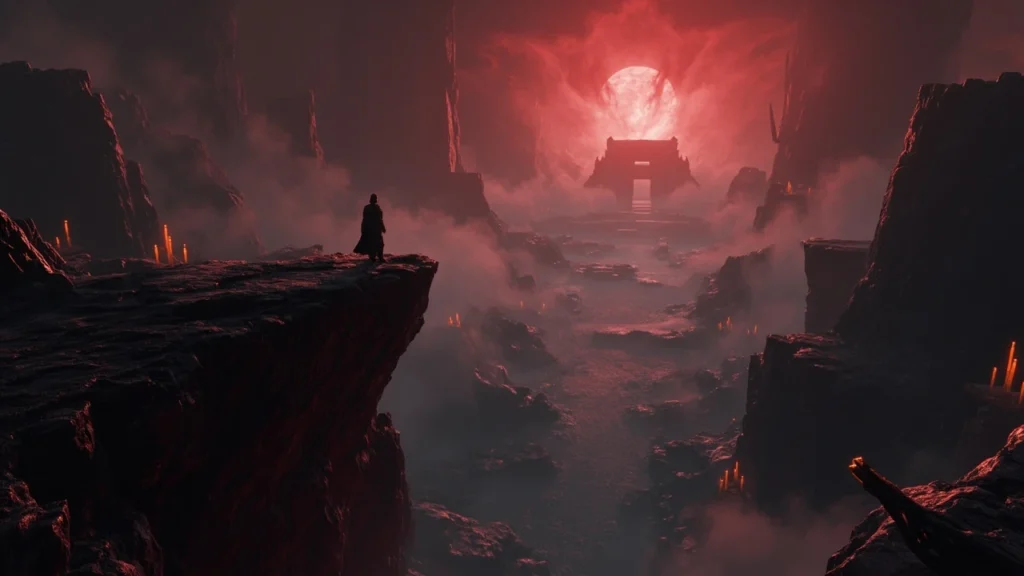
For design analysis, the interesting part is the moment immediately after the teleporter. The walkthrough describes stepping out of a pitch black cave onto a cliff, walking along the cliff edge, dropping onto a pillar, and then dropping again to ground level. A short climb back up a hill reveals a Golden Rune pickup and the Palace Approach Ledge-Road Site of Grace. That is an unusually long on-rails sequence for a single entry corridor in Elden Ring, and it does important work: it forces the player to commit to the area before they understand what is below them.
Landing the player: why the entry matters
Open-world games struggle with a consistent problem: when the player can enter an area from many directions, designers either have to build defensively in every direction or accept that the “intended” approach will often be skipped. Mohgwyn Palace uses a different solution. It funnels nearly every player through a vertical drop sequence, regardless of which teleporter they used.
That funnel does three things at once. First, it sets the camera angle so that the first time the player really sees the area, they are looking down at a plateau covered in small white shapes. Second, it gives the level designer control over where the player’s first combat will happen, because the descent ends at a known landmark (the Site of Grace). Third, it provides a built-in difficulty curve: even experienced players can take fall damage if they rush the drops, and that early resource loss frames the rest of the encounter as costly rather than free.
Layout and encounter design on the plateau
Once you reach the Palace Approach Ledge-Road, the region opens up into a long, sloped plateau. The plateau is mostly open ground with one major structural element: a small cliff face lined with Albinauric enemies. According to the walkthrough description, the white-flesh Albinaurics are non-aggressive and yield a high amount of runes, which makes the area famous for farming, while the red-flesh Albinaurics can roll into the player at high speed and are the real threat.
| Feature | Design role | Player consequence |
|---|---|---|
| Wide open plateau | Allows ranged and AoE builds to clear large groups | Rewards players who invested in late-game gear |
| Mixed enemy types (passive white, aggressive red Albinaurics) | Creates identification and prioritization challenges | Forces the player to read each enemy before engaging |
| Long sightlines to the mausoleum | Frames the final objective early | Encourages planning routes before charging in |
| Central path with side drops | Offers shortcuts and farming loops | Enables a fast, repeatable rune farm if the player wants it |
| Single nearby Site of Grace | Shortens the death-recovery loop | Keeps repeated farming runs low-friction |
From a level design standpoint, the plateau is essentially a single encounter room stretched across hundreds of meters. It is large enough that positioning matters, small enough that the player can see most threats at once, and dense enough that a poorly built character will be punished by repeated red Albinauric charges. That balance is harder to achieve than it looks, and it relies on enemy placement and AI behavior rather than terrain tricks. It is also worth noting that the same features that make the plateau dangerous for under-leveled characters make it efficient for farming runs once the player is over-leveled, which is exactly the dual outcome a designer would want from a high-density optional zone.
The Albinauric problem: passive mobs as a design tool
White-flesh Albinaurics in Mohgwyn Palace do not attack the player, and they die in a single hit. Mechanically, they are a farming resource. From a design perspective, they do something more interesting: they give the area a visible “background population” that makes the zone feel inhabited even before combat starts. They also create a real decision the player has to make every time they walk through.
- Do you kill the white Albinaurics for runes and risk aggroing nearby red Albinaurics?
- Do you ignore the white ones and walk past, losing a small but steady resource?
- Do you try to use a spell or weapon art that only hits the aggressive red variants?
That choice is small, but it is exactly the kind of micro-decision Elden Ring layers into its open world. By the time the player has reached the palace, they have already internalized how aggression, aggro range, and area-of-effect tools work, so a “filler” enemy type can still produce real engagement. Designers reading the area should note that “passive” enemies are not free content; they have to coexist with the active enemies in a way that does not break the encounter. White Albinaurics, in particular, can be exploited as a one-shot rune source only because the red variants create a real cost to chasing them, and that cost is what makes the loop feel like a choice rather than a chore.
Reaching the mausoleum and the boss
At the end of the plateau, the path descends into the Mohgwyn Dynasty Mausoleum. This is where the design shifts again. The mausoleum itself is a short, narrow indoor space, which contrasts with the wide outdoor plateau the player just crossed. That transition from open ground to tight corridors is a deliberate pacing tool: it resets the player’s muscle memory, narrows their field of view, and prepares them for a boss arena that is also unusually constrained.
The boss fight against Mohg, Lord of Blood takes place in a circular, vertical arena with blood-heavy visuals and a multi-phase moveset. Although the walkthrough excerpt focuses on reaching the area rather than the boss itself, the design logic is consistent with the rest of the region. The plateau teaches the player to manage mixed groups and sightlines, and the boss arena tests whether they can apply that discipline in a one-on-one context with blood loss as a constant threat. The shift in scale is also useful for technical reasons: a tighter boss room with concentrated VFX is easier for the engine to stream than a wide outdoor arena with the same particle budget.
How Mohgwyn Palace fits Elden Ring’s open world
Elden Ring’s structure is usually described as a series of “legacy dungeons” connected by open-world traversal. Mohgwyn Palace is neither. It is an optional micro-region with one dungeon (the mausoleum), one boss, and one major farming loop. That makes it a useful counter-example for developers who assume that every named location in an open-world game has to behave like a major area.
| Region type | Example in Elden Ring | Primary design goal |
|---|---|---|
| Legacy dungeon | Leyndell, Royal Capital | Multi-hour progression with branching paths |
| Open-world zone | Limgrave, Caelid | Free traversal, exploration, and discovery |
| Optional micro-region | Mohgwyn Palace | Compact, high-density challenge with one main objective |
| Linear side dungeon | Most catacombs and caves | Short, focused combat puzzle with a single reward |
The “optional micro-region” pattern is the one Elden Ring uses least often, which is why Mohgwyn Palace stands out. It gives the game a way to deliver a memorable boss, a long-lived farming spot, and a memorable visual without paying the cost of building another large zone. For developers, the question is when to use this pattern instead of a full zone, and Mohgwyn Palace is a clean example of the trade-offs. The answer, in this case, is “when the player already has the gear to clear a dense area quickly,” because the entire design assumes a character who can delete passive mobs and kite aggressive ones without dying to a stray roll.
Design lessons from the palace
Looking at the region as a case study, a few patterns stand out that are useful for anyone designing open-world or hub-style areas.
- One entry funnel, many surface paths. Even though the palace can be reached through two teleporters, the actual entry sequence is the same for almost every player. The funnel controls the player’s first impression, and the path variety sits above the funnel rather than at the door.
- Short geography, high density. Mohgwyn Palace is small on the map but filled with enemies, pickups, and objectives. That ratio is harder to design than a large sparse zone, because every meter has to do work.
- Mixed enemy roles in a single encounter. Passive and aggressive variants of the same enemy family in the same space create decisions that are larger than the enemies themselves.
- Visible objective from the entry point. The mausoleum is visible from the plateau for most of the approach, which gives the player a target without exposing the final arena.
- Reward loop that survives the player. The farming use of the area means many players will visit dozens of times. That requires the encounter to remain readable and consistent across repeated runs, not just the first one.
Each of these lessons is cheap to copy in isolation, but they only work together. A high-density area without a funnel entry turns into noise; a funnel without a visible objective turns into a corridor; a farming loop without a consistent encounter turns into a chore. The palace gets away with being dense because every other design choice is also pulling in the same direction.
Common player problems and how the design addresses them
Even in a small region, players run into predictable issues. The design answers most of them either through level layout or through enemy AI, which is a useful sign that the area was playtested heavily before release.
| Common problem | Where it happens | How the design handles it |
|---|---|---|
| Fall damage on entry | Pillar drop from the cave to the plateau | A clear landing target and a nearby Site of Grace reset the player |
| Being rushed by red Albinaurics | Cliff face near the approach | Open ground around the cliff gives ranged players room to kite |
| Losing runes on death | Anywhere on the plateau | Short distances between death location and Site of Grace make recovery cheap |
| Underestimating the boss | Mausoleum entrance | Tight corridor forces a pause before the boss fog gate |
| Overfarming and losing track of objectives | Late stages of a run | Visible mausoleum silhouette and consistent audio cues keep the goal salient |
Notice that none of these solutions rely on UI cues or pop-up tutorials. The level geometry does the work. That is one of the strongest arguments for studying the palace as a designer: it shows how much information a level can encode without ever opening a help screen, and it does so in a region that most players reach only after dozens of hours of play. For a team trying to ship onboarding-free design, that is a useful data point.
Performance, streaming, and technical considerations
From a runtime perspective, an area like Mohgwyn Palace has to satisfy a few different constraints at once. The open plateau is wide enough that the streaming system has to manage many enemy actors and a large terrain chunk. The mausoleum is the opposite: a tight, instanced-feeling space that needs to load quickly when the player descends. Elden Ring generally handles this by treating the mausoleum as a separate sub-area with its own loading and lighting setup, and the plateau as a larger streaming cell tied to the Siofra River region above it.
- The plateau uses consistent outdoor lighting that is heavy on red and shadow, which helps mask streaming pop-in by keeping the eye on silhouettes rather than fine detail.
- The mausoleum switches to a darker, more controlled palette so the player reads it as a different space even before any UI tells them so.
- Particle and blood FX are concentrated near the boss arena to keep heavy VFX cost out of the open plateau, where many enemies are already active at once.
None of this is documented in official technical material, and exact budgets vary by platform, but the design choice to keep high-cost effects clustered near the boss is a reasonable inference from how the rest of Elden Ring distributes its heaviest visuals. For developers, the takeaway is that a small region can still benefit from deliberate streaming and lighting separation, even when its total polygon count is modest. The same logic applies to audio: the plateau uses ambient wind and distant crashes, while the mausoleum switches to a more enclosed, reverbed sound profile that telegraphs the boss room before the fog gate is in view.
How Mohgwyn Palace compares with other optional late-game zones
It is worth comparing the palace with two other Elden Ring regions that also feel “late-game and optional,” because the contrast makes the design intent clearer.
| Region | Size | Main purpose | Typical visit count |
|---|---|---|---|
| Mohgwyn Palace | Small | Boss, farming, reward | Many (farming), few otherwise |
| Consecrated Snowfield | Medium | Exploration, hidden questlines | One to three |
| Lake of Rot | Small to medium | Linear challenge, key item | One to two |
The palace is unusual because the optional content is not the boss; it is the farming loop. Most optional late-game zones are designed for a single thorough playthrough, but the palace is built so that a player who is not interested in the boss will still visit it dozens of times. That dual purpose is the real design innovation, and it is the reason the area is still discussed years after release. It also has a secondary effect: because the plateau remains useful at any level, it acts as a soft difficulty curve for players who have skipped ahead of the recommended story order, which is a useful safety valve for a non-linear game.
What developers can reuse, and what they should not copy directly
It is tempting to treat Mohgwyn Palace as a template, but the design only works because the rest of Elden Ring supports it. The same approach in a different game would feel hollow without those supports.
- Reuse: the idea of a high-density optional micro-region with a single funnel entry and a clear long-range objective.
- Reuse: the practice of layering passive and aggressive enemy variants in the same space to create small but real decisions.
- Reuse: the use of a visible landmark (the mausoleum) to orient the player without breaking exploration.
- Do not copy directly: the specific reward balance. Farming viability depends on the rest of the game’s economy, and copying the palace’s rune output into a different progression system would trivialize that system.
- Do not copy directly: the teleporter-based access. That pattern works because Elden Ring is built around fast travel; a game without it would need a different solution for late-game optional content.
Developers should also be careful about scaling. A micro-region that works in a 60-hour game may feel insulting in a 20-hour game, because the player’s tolerance for repeated farming runs is tied to how much progression they expect per hour. Mohgwyn Palace is, in that sense, a luxury pattern: it is only available because Elden Ring has already earned the player’s time elsewhere.
Planning a build before you enter
Although this page is design-focused, a short practical section is useful because the design only works when the player is actually ready for it. The plateau punishes fragile builds, and the boss punishes builds that cannot handle repeated blood loss. A reasonable preparation checklist looks like this:
- Confirm you are comfortable with your current rune level. The area’s enemies are tuned for late-game characters, and being under-leveled turns the plateau into a wall.
- Bring at least one ranged option or area-of-effect spell. The mixed Albinauric group is much easier when you can hit multiple targets from a distance.
- Prepare a counter to blood loss. The boss relies on it, and ignoring that mechanic will end the fight quickly.
- Carry a summon or ash of war that can hold aggro. The open plateau is friendlier when something else is drawing the red Albinaurics’ charges.
- Decide in advance if you are there for the boss, the farm, or both. Trying to mix the two without a plan usually ends with a wasted rune drop.
If you are running the area as a farm, the order of operations matters as much as the build. Clear the red Albinaurics first, then sweep the white ones, then reset at the Site of Grace. Reversing that order tends to aggro more red variants than a melee build can safely handle, and it is the most common reason farming runs end early.
When the region feels “broken” and what that tells us
Some players describe Mohgwyn Palace as one of the easiest or hardest areas in the game depending on build. That split is not a bug; it is a signal that the design is tightly coupled to specific build assumptions. If you are using a ranged, heavy-AoE character, the plateau collapses. If you are using a slow melee character with no answer to rolling enemies, the same plateau becomes a nightmare. Designers reading the area should treat that variance as evidence that a small, dense region magnifies build differences far more than a large open zone does. In a large zone, the player can route around their weaknesses. In Mohgwyn Palace, there is nowhere to route.
That amplification effect is a double-edged tool. It is exactly what makes the area satisfying for optimized builds and punishing for casual ones, but it also means a small balance change can swing the encounter in either direction. A single red Albinauric that hits a little harder, or a white Albinauric that drops a few more runes, can move the plateau from “fair challenge” to “trivial farm” or from “fair challenge” to “wall.” Small regions, in other words, leave less headroom for tuning.
Why the palace still matters in 2026
Several years after release, Mohgwyn Palace is still a frequent reference point in discussions of Elden Ring design, and that staying power comes from a small number of decisions. It is one of the few areas in the game that works as a hub rather than a linear path. It is one of the few areas where passive enemies matter. It is one of the few areas where the entry sequence is the same for almost every player, regardless of how they reached the zone. And it is one of the few areas where the reward loop is designed to outlive the player’s first visit.
For a working designer, that combination is more useful than any single trick. The lesson is not “add a farming zone” or “add a teleporter.” The lesson is that optional content can carry its own structure, its own pacing, and its own reward loop, and that doing so does not require a second open world. It also shows that “optional” does not have to mean “throwaway.” A well-designed optional region can carry as much identity as a main-story dungeon, and in some cases more, because the player visits it on their own terms and remembers the experience for the wrong reasons if it is done badly.
A useful reference for the entry sequence and plateau layout described throughout this page is the official walkthrough and location guide for the region, which documents the teleporter, the cave exit, the pillar drop, and the Albinauric population in detail. IGN’s coverage of the location and walkthrough walks through the same path that the design analysis above is built on, and it is worth reading alongside this piece if you want to compare the player-facing description with the level-design reading.
Frequently asked questions
Where is Mohgwyn Palace located in Elden Ring?
Mohgwyn Palace is an optional underground region found beneath the Siofra River area. It is accessed either through a teleporter reached via the Haligtree Secret Medallion in the Mountaintops of the Giants, or earlier through White-Faced Varre’s questline. The palace itself contains the Mohgwyn Dynasty Mausoleum and the optional boss Mohg, Lord of Blood.
What level should I be before entering Mohgwyn Palace?
There is no fixed level requirement, but the area is tuned for late-game characters. If you are consistently dying to groups of enemies in other open-world regions, you are likely under-leveled for the palace. A good rule of thumb is to be comfortable with the difficulty of Leyndell or the Mountaintops of the Giants before attempting the mausoleum boss.
Is Mohgwyn Palace required to finish the game?
No. The palace is fully optional. You can finish the main story without entering it, and you can ignore the boss entirely. The area is most often visited either for the boss’s Great Rune and Remembrance, or for the farming loop on the plateau.
How do you reach the palace without the Haligtree Secret Medallion?
You can reach the palace by following White-Faced Varre’s questline, which gives you access to a different teleporter earlier in the game. This route is the reason the area is accessible to characters who have not yet reached the Consecrated Snowfield.
Why is Mohgwyn Palace so popular for farming runes?
The plateau is populated by white-flesh Albinaurics that are non-aggressive and die in a single hit, but they still drop a high amount of runes. Combined with a nearby Site of Grace, this creates a fast, repeatable loop that is much more efficient than most other farming locations in the game.
What is the boss of Mohgwyn Palace?
The boss is Mohg, Lord of Blood, an optional boss who drops a Great Rune and a Remembrance. The fight is known for its multi-phase moveset, heavy blood-loss pressure, and a circular arena with a distinct visual identity that separates it from the rest of the underground.
Can you co-op in Mohgwyn Palace?
Yes. Like most of Elden Ring, the region supports both summoning other players and using spirit ashes. Co-op is particularly useful on the plateau, where multiple red Albinaurics can be drawn at once, and for the boss fight, which has a steep learning curve.
What rewards does the area give besides the boss drops?
Beyond the boss’s Great Rune and Remembrance, the plateau contains several pickups, including a Golden Rune near the entry path. The mausoleum itself holds a small number of additional items tied to its side rooms, though most of the area’s long-term reward comes from the farming loop rather than unique loot.
Is the palace accessible in new game plus?
Yes, and the design assumptions carry over. The plateau is still tuned for late-game characters, the boss still requires a build that can handle blood loss, and the farming loop still works as long as the rest of your build is intact. New game plus tends to make the plateau more dangerous rather than less.
What should a developer take away from this area?
Three things. First, optional content can be a self-contained hub instead of a linear path. Second, mixed enemy roles in a small space create more decisions than they appear to. Third, a clearly visible long-range objective does more work for player orientation than any UI marker would, as long as the level geometry funnels the player toward it.