Comparing Datacenter, Residential, and Mobile Proxy Types

The Variety of Proxy Types
Proxies are an essential piece of infrastructure when it comes to the safe Internet connection and cyber security industry. They help to boost the connection’s speed, privacy, traffic monitoring, geo-blocking, and so much more. We can think of many proxy types. But only three of them have a particular status for their characters and activity areas: datacenter, residential, and mobile proxies.
Learning the differences between these proxies will enable companies or individuals to tailor their online behavior. This comparison review contrasts the technical specifications, benefits, limitations, and use cases for datacenter, residential, and mobile proxies to help make educated decisions.
What are Proxies?
A proxy server stands between a single client and the rest of the Internet, forwards clients’ requests to the target servers, and gets back the results.
This process effectively conceals the client’s IP address, making it anonymous and bypassing network blocking. Proxies can also be used to enhance security, increase network throughput by cache, and distribute the work on servers by load balancing.

Proxies are defined by the origin and route to their IP addresses. These categories consist of datacenter proxies, residential proxies, and mobile proxies.
Datacenter Proxies
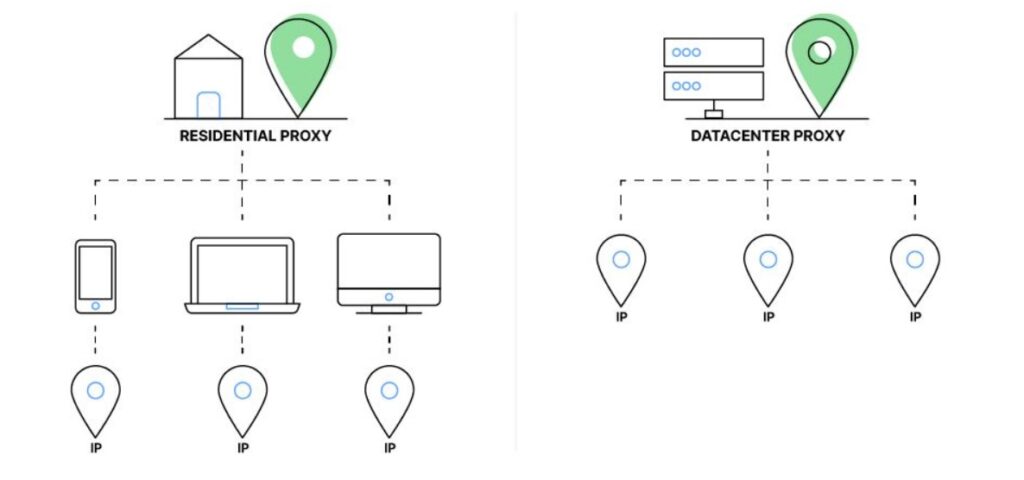
A datacenter proxy is a server that has IP addresses from the data centers. Their IP addresses are not associated with ISPs that offer residential Internet service. Instead, they are purchased from secondary companies and hosted physically in data centers, with powerful servers and high-speed networking.
The technical infrastructure of the datacenter proxy consists of virtual or physical servers in datacenters, which host massive collections of IP addresses.
Since the data center’s network has typically very high bandwidth and low latency, these proxies are able to accommodate massive volumes of traffic. They tend to have high-end hardware so that the connection is fast and stable.
Advantages of Datacenter Proxies
The biggest benefits of datacenter proxy types are speed and performance. Datacenters also have powerful proxy servers and super-fast connections, so they can move data at very high rates. They do work for applications where high response times are required.
In addition, datacenter proxies are less expensive than residential or mobile proxies as the infrastructure cost for datacenter is split amongst a large client base.
Another good feature is that they’re scalable because if demand goes up, datacenter proxies can increase capacity in the shortest time — they simply add more servers or IP addresses from a datacenter’s pool.
Limitations of Datacenter Proxies
Despite these performance benefits, datacenter proxy has serious drawbacks. It’s so easy to fingerprint their IP addresses as coming from a datacenter, which makes them much more susceptible to being blocked by sites with anti-bot or IP filtering.
These proxy types have certain disadvantages as well – lack of IP diversity and residential legitimacy would also greatly inhibit activities that demand extreme anonymity or mimic typical user behavior.

Also, the data center proxies can be on a shared subnet or range, and it is pretty straightforward for target servers to block several proxies at once. Such an exploitation flaw stymies activities through persistent access to specific websites or services.
But datacenter proxies may lack access to locations like a residential or mobile proxy, and this can affect its overall performance for some location-based applications.
Residential Proxies
Residential proxy types addresses use ISP-managed IP addresses issued to the owner. These IP addresses are associated with physical locations and true residential internet access. Hence, they would represent the identity of a true residential subscriber to the target servers.
Residential proxies redirect traffic through devices connected to residential networks either through peer-to-peer networks or by contracts with ISPs. It is also worth watching this video that explains in detail the terms and use of residential proxies.
Advantages of Residential Proxies
The biggest advantage of residential proxy types is that they are trusted and anonymous, meaning that websites will not typically flag or block them simply because these are legitimate residential ones. This, in fact, ensures excellent access at low risk of detection.
That’s why residential proxies are perfect for things such as web scraping, ad verification, and geo-blocking.
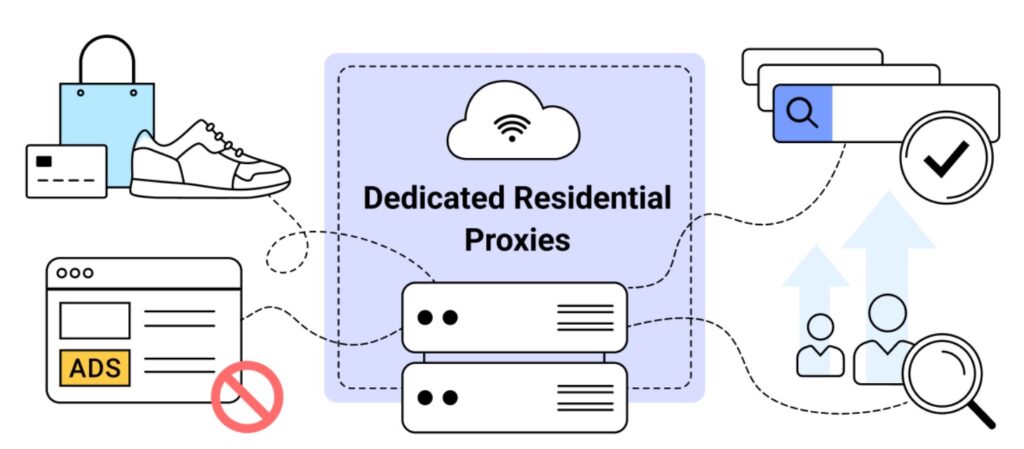
Residential proxies also ensure geographic coverage. It is all about IP address — providers typically own IP addresses for thousands of countries around the world that allow users to mimic remote access. Such geographical variation is crucial for applications that need to access or test content locally.
Limitations of Residential Proxies
The biggest issue with residential proxy types is the price. It takes a lot to build and maintain a residential IP address network, and this is directly reflected in customer prices.
Although datacenter proxies are relatively inexpensive, residential proxies are typically very costly and therefore unsuitable for some users.
Besides this, residential proxies can deliver performance through fluctuating connection rates and reliability. Because the proxies themselves connect over residential networks, they will experience changes within those networks – such as lower bandwidth and higher latency versus the datacenter connections.
Mobile Proxies
Mobile proxies use IP addresses assigned to mobile phones by mobile network operators (MNOs). They refer to IP addresses that are tied to mobile data lines (for example, 3G/4G/5G networks).
Mobile proxies forward traffic via mobile devices connected to cellular networks, giving you a tremendous level of legitimacy and anonymity as mobile IP addresses change. We’ve reviewed in our guide about mobile proxy apps how this feature can be good for you.
The technical infrastructure uses a cluster of phones or modems as proxy nodes. Operators can either connect devices with SIM cards to mobile networks or employ software tools to extract the IP addresses of mobile phones (subject to consent).
Advantages of Mobile Proxies
Mobile proxies have the most trust and anonymity of all three proxy types. Websites and services do not block mobile IP addresses because it is tough to distinguish authenticated from proxy traffic. Every tech-savvy user can set them up – for example, check this Reddit thread where users share their experiences with mobile proxies.

The rotating nature of mobile IP addresses, given via DHCP by MNOs, provides an additional layer of anonymity.
These proxies are good for evading anti-bot and security restrictions. Social media management, mobile app testing, and bypassing firewalls all benefit from mobile proxies.
Limitations of Mobile Proxies
The main drawback to mobile proxy types is their price. They are the most expensive proxy types because of the challenges of running a network of phones and data plans. Mobile IP addresses are less plentiful compared to residential and datacenter IPs, too.
Mobile proxy services may also incur connection delays and latency. Cellular networks have a lower bandwidth than a wired connection, which can slow performance for heavy-duty applications.
Comparison of Different Proxies
- Performance and Speed
The bandwidth and high server horsepower of datacenter proxies ensures superior speed and performance. They are ideal for applications that need to move large amounts of data at low latency.
Residential proxy provides a relatively average performance, and rates vary widely depending on the residential internet connectivity being used. Mobile proxies have the lowest bandwidth since mobile networks aren’t ideal for high speed.
- Anonymity and Privacy Concern
Mobile proxy types offer the most anonymity and trust because mobile IP addresses are less likely to be blocked and are recognized by most services. Residential proxies are also highly trust-rated because they disguise themselves as everyday homeowners.

The lowest trust is for datacenter proxies, the more likely they are to get blocked or flagged since they are quickly recognizable as not-residential and proxy or VPN services.
- Cost
The other major distinguishing factor between these three types of proxies is cost. Datacenter proxies are the fastest and most inexpensive means to access proxies at a reasonable cost.
Also, residential proxies are more expensive because, to set up the network and support it, it costs more to purchase and manage residential IP addresses. The most expensive is the mobile proxy, which requires mobile phones with data plans to allocate mobile IP addresses.
Conclusion
Proxy at the datacenter, at home, and on the go each have different benefits and limitations. The trick is to know these distinctions so that they can be best used across applications.
Datacenter proxies are fast and inexpensive but may not be anonymous enough for certain purposes. Residential proxies provide the right balance of efficiency and legitimacy and are perfect for any activity that demands increased trust.
Mobile proxies provide unrivaled anonymity and trustworthiness but also at a higher price tag and potential performance compromises.
We hope that you loved our guide dedicated to the use of different proxy types. Make sure to bookmark the website of Kimli Soft and follow our blog for new updates.