Battlefield 6 Campaign: Missions, Squad, and How It Plays
Battlefield 6 campaign guide covering Dagger 1-3, mission types, Pax Armata, and gameplay systems in the Battlefield 6 single player mode.
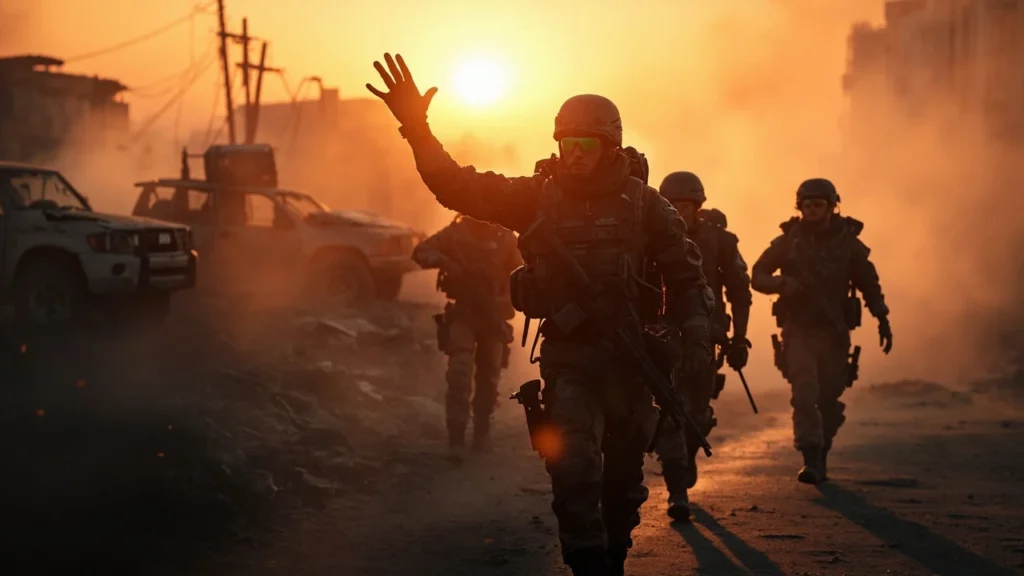
Battlefield 6 campaign: what players actually step into
The Battlefield 6 campaign puts you in control of Dagger 1-3, an elite unit of Marine Raiders deployed against Pax Armata, a private military corporation that hires mercenaries from across the world. The story frames a near-future NATO collapse and hands you a sequence of combined arms operations that range from a beach assault on Gibraltar to a HALO jump into contested territory, with street-level fighting in Brooklyn between those bookends. The single player experience is built to translate Battlefield’s large-scale combat vocabulary into a structured mission arc, and that translation shapes nearly every design decision a player will notice in motion.
Because Battlefield has historically been a multiplayer-first franchise, the campaign has to do extra work to justify itself. It needs a reason to exist beyond a tutorial, a roster of set pieces that feel distinct from a 64-player match, and a squad of named characters that can carry the narrative between firefights. Understanding how Dagger 1-3 is assembled, what each mission is actually asking the player to do, and how the engine handles the signature Battlefield moments in a single-player context gives a more honest read of the mode than any marketing summary can.
The Dagger 1-3 squad and how Battlefield 6 uses named characters
Battlefield 6 does not ask the player to embody a single silent protagonist. Dagger 1-3 is a small, defined unit, and the campaign shifts perspective between its members rather than locking the player to one face for the full runtime. That decision matters because it changes how the game frames information, how it distributes gameplay responsibilities, and how cinematics are staged.
A multi-protagonist squad lets the writers route specific mission types through the character whose skill set matches the task. A demolitions specialist can carry a level built around breaching a hardened position, while a recon-focused operator can front a mission that depends on spotting targets and calling supporting fire. From a production standpoint, this also lets the team reuse the same set of player animations and weapon handling across multiple characters without forcing every operator to behave identically, which would be a visible weakness during close-quarters firefights.
The trade-off is continuity. A player who bonds with one character will spend a significant portion of the campaign looking over that character’s shoulder rather than at the back of their head. Battlefield 6 addresses that by keeping the cast small and by tying each member to a recognizable role within the squad, so the switching feels structural rather than arbitrary.
Pax Armata as a campaign antagonist
Pax Armata is written as a private military company that recruits mercenaries motivated by personal gain, adventure, and the prospect of a new life rather than by national loyalty or ideology. That framing is deliberate, because a stateless antagonist lets the writers move the conflict across multiple theaters without the political baggage that would come with a real-world state actor. Gibraltar, Brooklyn, and the HALO drop zone can all belong to the same campaign without forcing a single diplomatic justification.
Mechanically, a PMC roster also changes how the game presents its enemies. These are trained professionals, not insurgents, so they can be relied on to use cover, communicate, employ vehicles, and occasionally outflank the player in ways that would feel out of place for a militia faction. The encounter design leans into that, with set pieces that assume the opposing force has access to similar equipment, air support, and armor as the player’s own side. It is the difference between a fight against a smaller mirror image and a fight against a force that simply has different orders.
What the antagonist choice means at the mission level
- Enemy units can field technicals, armored transports, and anti-aircraft assets, so single-player AI has to coordinate against them rather than simply rush the player position.
- Mission objectives frequently include disruption of PMC logistics, since the enemy’s strength is its supply line, not its ideology.
- Civilian presence is light but meaningful, reinforcing the corporate-mercenary framing without forcing the player into morality puzzles that do not match Battlefield’s combat focus.
Mission structure across the Battlefield 6 campaign
The campaign covers a recognizable arc. It opens with a large-scale amphibious assault on Gibraltar, moves through an urban operation in Brooklyn, includes a HALO jump into hostile territory, and closes with operations that consolidate the earlier set pieces. That sequence is not accidental. It mirrors the way Battlefield multiplayer maps are designed: each environment is built around a specific combat problem, and the campaign strings those problems together to teach the player how the engine handles different scales of engagement.
How each mission type stresses a different Battlefield system
| Mission type | Primary system under test | Typical squad role | Failure mode a player should expect |
|---|---|---|---|
| Beach assault (Gibraltar) | Combined arms coordination, vehicle use, suppression | Point element leading the landing | Overextending past armor cover and being isolated from support |
| Urban combat (Brooklyn) | Close-quarters firefights, verticality, civilian footprint | Room-clearance and street-level overwatch | Pushing through open intersections without clearing adjacent windows |
| HALO jump insertion | Approach planning, stealth approach, timing of first contact | Recon or pathfinder | Drifting off the drop zone and triggering early alarm states |
| Sustained ground operations | Squad-based tactics, sustained firefights, resource pressure | Rotating between breach, support, and overwatch roles | Spending medical or explosive resources early and running dry before the final objective |
The table is not a difficulty ranking. It is a map of which engine systems each mission asks the player to engage with. A player who struggles on the HALO jump is unlikely to be helped by the same advice that solves a Brooklyn room-clearance problem, and treating the campaign as a single escalating challenge tends to mask that.
Gameplay systems Battlefield 6 carries from multiplayer into the campaign
Battlefield’s identity is built on a small number of mechanical pillars: large maps, destructible environments, vehicle play, class-based loadouts, and combined arms coordination. The campaign is not a separate game with separate rules, so the single player mode has to translate each of those pillars into something a single human player can drive.
Destructible environments in single player
Destructible cover is one of the more obvious carryovers. In multiplayer it is a way to force opponents out of entrenched positions; in the campaign it is a way for the level design to give the player a visible feedback loop when an approach is failing. A wall that was solid when the mission started is rarely solid by the time the player has cleared the area, which means cover decisions are short-lived and tactical positioning has to be re-evaluated frequently.
That has implications for how the player should think about loadout. A heavy armor plate is less useful on a map where the cover it relies on is likely to be reduced to rubble within the first minute of the assault. Lighter, more mobile kits tend to survive the destruction cycle better, particularly in missions like the Brooklyn sequence where the urban grid is the main battlefield.
Vehicle use without a full driver roster
Battlefield multiplayer assumes that any vehicle in the field has a human driver. The campaign cannot make that promise, so AI drivers and scripted vehicle sections step in. That changes how the player interacts with armor and aircraft. Vehicle combat in single player tends to be framed as a guided sequence rather than a freeform engagement, with the player either operating a turret, directing an AI crew, or completing an on-rails objective that uses the vehicle as a moving set piece rather than a controllable asset.
Players who try to drive every vehicle as if it were a multiplayer match will find the campaign awkward, because the scripting is not built around freeform driving. The intended pattern is to treat vehicles as mission tools, with the actual piloting handled by squadmates or by fixed sequences.
Class-based loadouts in a single-player context
Class systems in single-player games often feel vestigial because the player is the entire team. Battlefield 6 handles this by tying class identity to squadmate behavior and to the player’s starting equipment rather than locking the player into a single role. The player can still pick a class archetype at the start of a mission, and the squad’s supporting fire and ability usage shifts to match, but mid-mission role switching is supported in a way that single-player Battlefield games have not always handled gracefully.
- Assault-oriented loadouts reward aggressive pushes and are the natural fit for the Gibraltar beach landing and similar breach missions.
- Engineer loadouts are tuned for vehicle-heavy sections where destroying armor is a primary objective.
- Recon loadouts support the HALO-style insertions and any mission that depends on spotting targets before contact.
- Support loadouts keep the squad sustainable across longer operations, which is the relevant consideration in sustained ground missions.
How the campaign is paced across its runtime
Battlefield 6’s single player is not structured as a single escalating difficulty curve. It is a sequence of distinct set pieces, each with its own internal rhythm. The pacing between those set pieces matters as much as the set pieces themselves, because the campaign has to recover the player between high-intensity moments without losing momentum.
Set piece design in practice
A set piece in this context is a scripted sequence that combines staging, audio, and gameplay to produce a moment that the player will remember. The Gibraltar amphibious assault, the Brooklyn street fighting, and the HALO jump are all set pieces by that definition. Each one is staged with explicit visual cues that signal the transition into and out of the scripted phase, which helps the player understand when the game is asking them to follow a specific path and when they are back in a more freeform engagement.
That distinction is not always obvious on a first playthrough. Players who try to freelance too aggressively during a set piece will usually find their progress halted by invisible walls, scripted enemy spawns, or a forced failure state. Players who treat every minute of the campaign as a freeform sandbox will find the experience frustrating. The intended pattern is to recognize the visual and audio cues that mark a set piece, follow the designed path through it, and then resume a more flexible play style once the game returns to standard combat.
Recovery beats between set pieces
Between the large set pieces, the campaign inserts shorter combat sections that are designed to drain tension rather than build it. These are the moments where the squad is moving to the next objective, the player is gathering ammunition, and the AI is handling most of the heavy lifting. Their purpose is pacing. Without them, the campaign would feel like a continuous escalation with no breath, and the set pieces would lose their impact because the player would have no time to reset between them.
Players who skip these beats by sprinting past them will often find the next set piece feels overwhelming, because they have not given the engine a chance to reset their state. A short period of movement between fights is part of the campaign’s intended design, not a slow section to be optimized away.
Combat AI and how the player should expect enemy behavior to change
Pax Armata is presented as a professional force, and the AI is written to reflect that. Enemy soldiers use cover, attempt to flank, and respond to the player’s use of grenades and suppressive fire. They are not scripted to rush the player position the way a militia faction often is in single-player shooters, which means the player has to treat each engagement as a tactical problem rather than a target-rich environment.
Patterns a returning player will start to recognize
| AI behavior | What it looks like in motion | How the player should respond |
|---|---|---|
| Suppressive fire | Enemies lay down continuous fire from a fixed position while a second element moves | Use smoke or a flanking route to break the suppression before the second element arrives |
| Flanking attempt | Two or three soldiers peel off the main line and move to the player’s side | Watch the flanks during sustained firefights and rotate to intercept before the flank is set |
| Grenade usage | Enemies throw grenades into entrenched positions rather than charging in | Keep an escape route clear and treat any held position as temporary |
| Armor callouts | Enemies mark the player’s position for vehicle or air support | Move immediately after being spotted rather than finishing a fight in the open |
The table is not a complete AI behavior list, and individual encounters will deviate from these patterns. The point is that the AI is designed to punish a static play style, and players who plant themselves in a single position for the duration of a fight will find the difficulty curve steeper than it needs to be.
How Battlefield 6 handles difficulty and player death
Single-player Battlefield games have historically struggled with difficulty, because the franchise’s multiplayer design assumes a specific skill floor that does not always translate to a solo player. The campaign addresses this with a layered difficulty model rather than a single number that scales enemy health and damage.
On lower difficulty settings, the AI is less aggressive, ammo is more plentiful, and the player has more margin for tactical mistakes. On higher settings, the AI uses the full range of behaviors described above, ammunition is more constrained, and the player is expected to use the squad’s supporting abilities to manage engagements rather than to absorb damage directly.
Death in the campaign is treated as a learning signal rather than a failure state. The default respawn distance is short, and the player returns to the same engagement with the same equipment rather than restarting the mission. That design choice rewards experimentation, because the cost of trying a different approach to a fight is measured in seconds rather than minutes.
Player progression and unlocks within the campaign
The campaign includes a progression layer that is distinct from the multiplayer progression. Players earn experience and unlock equipment as they complete missions, with rewards weighted toward gear that is useful in the next mission rather than a long tail of cosmetic items. That design choice is deliberate, because the campaign does not want the player to feel that they are playing a side mode that is gated behind a different progression curve.
How campaign progression differs from multiplayer progression
- Campaign unlocks prioritize equipment that matches the next mission’s expected combat profile, not a long tail of cosmetic items.
- Weapon unlocks are tuned for single-player AI behavior rather than for player-versus-player balance, which means some weapons feel different in the campaign than they do in multiplayer.
- Class unlocks are tied to squad composition, so unlocking a new class changes how the squad behaves in subsequent missions rather than simply changing the player’s starting kit.
Players who want to use a specific loadout in a specific mission should check the mission’s recommended loadout before they start, because the campaign is not built around a single kit that can be carried unchanged from the first mission to the last.
Visual and audio design in the campaign
The campaign’s visual identity is built around the contrast between the wide, open terrain of the Gibraltar assault and the dense, vertical urban grid of the Brooklyn operation. Those two environments are not interchangeable, and the engine is tuned to make each one feel distinct. The beach assault emphasizes long sightlines, vehicle traffic, and the visual chaos of a contested landing. The Brooklyn mission emphasizes short sightlines, vertical cover, and the constant pressure of multi-story buildings that can hold enemies on every floor.
Audio design follows the same logic. The HALO insertion is staged as a quiet approach with environmental sound foregrounded, then explodes into a full combat mix once the player reaches the ground. The Brooklyn mission is loud from the first frame, with suppressed gunfire, distant impacts, and the constant audio texture of an active urban firefight. The campaign is not consistent in its audio palette by accident. It is using audio to mark the transition between mission types the same way the visuals do.
Where the Battlefield 6 campaign fits inside the wider franchise
Battlefield’s single-player history is uneven. Some entries in the franchise have used the campaign as a way to teach players the engine’s mechanics before they go into multiplayer, and others have used it as a self-contained narrative that exists alongside the multiplayer mode. The Battlefield 6 campaign is closer to the second pattern, with a story arc that is built to be played on its own terms rather than as a tutorial for the multiplayer modes.
That choice has trade-offs. Players who want a single-player experience that teaches them the multiplayer game will not find it here, because the campaign’s encounter design is tuned for solo play rather than for the player-versus-player balance that drives the multiplayer side of the game. Players who want a self-contained military narrative that uses Battlefield’s combat vocabulary will find the campaign more coherent, because the design is not constantly being pulled in two directions at once.
How to get the most out of a first playthrough
A first playthrough of the Battlefield 6 campaign is the player’s best opportunity to learn the engine’s combat rhythm, because the mission sequence is designed to introduce systems in a specific order. Players who try to skip ahead or who play the missions out of order will lose that progression curve, and the campaign’s later missions will feel more arbitrary than they need to.
Practical checks for a first playthrough
- Start on the default difficulty and adjust only after the first set piece, because the early missions are calibrated to teach the core mechanics at that setting.
- Use the squad’s supporting abilities early and often, because the AI behavior is designed to respond to suppressive fire and grenade usage in ways that change the shape of the engagement.
- Do not sprint through the recovery beats between set pieces, because the pacing is part of the design rather than a slow section to be optimized away.
- Experiment with classes across the first three missions rather than committing to a single role, because the campaign’s later missions expect the player to be flexible.
- Pay attention to audio cues during set piece transitions, because the engine signals the boundary between scripted and freeform play in ways that are not always visually obvious.
None of these checks are mandatory, and experienced Battlefield players will find their own approach. The list exists because the campaign has a designed progression, and a first playthrough that respects that progression will feel more coherent than one that tries to bypass it.
Frequently asked questions
How long is the Battlefield 6 campaign?
EA’s official campaign feature page describes a sequence of large-scale operations including a beach assault on Gibraltar, urban combat in Brooklyn, and a HALO jump into enemy territory, but it does not publish a specific hour count. The actual length depends on the player’s difficulty setting, their familiarity with Battlefield’s combat systems, and how much time they spend exploring the recovery beats between missions. Players who push through the set pieces efficiently will see a shorter runtime than players who treat every recovery beat as a chance to clear the surrounding area.
Can the Battlefield 6 campaign be played in co-op?
EA’s campaign page presents Battlefield 6’s single player mode as a Dagger 1-3 squad experience, with the player stepping into the role of different squad members across the campaign. The page does not describe a co-op mode for the single player story. Co-op play in Battlefield 6 is associated with the multiplayer modes rather than the campaign, so players looking to play with a friend should expect to do so in the multiplayer side of the game rather than in the campaign.
Does the Battlefield 6 campaign connect to the multiplayer modes?
The campaign is built around the Dagger 1-3 squad and the conflict with Pax Armata, and it uses the same engine, weapons, and core combat systems as the multiplayer side of the game. It does not, however, function as a tutorial for multiplayer. The encounter design is tuned for solo play, and the loadout balance is not identical between the two modes. Players who want to learn multiplayer-specific skills should expect to spend time in the multiplayer modes directly rather than expecting the campaign to teach them.
What role does the player play in the Battlefield 6 campaign?
The player controls members of Dagger 1-3, an elite squad of Marine Raiders. The campaign shifts perspective between squad members rather than locking the player to a single protagonist for the full runtime, and each squad member has a role that shapes the kind of mission they front. The player is part of a combined arms operation, not a lone wolf, and the AI squadmates are written to provide supporting fire, breach charges, and recon support rather than to follow the player silently.
Who is Pax Armata in Battlefield 6?
Pax Armata is presented as a private military corporation that hires mercenaries from around the world. According to EA’s campaign page, the soldiers are trained professionals motivated by personal gain, adventure, and the desire for a new life rather than by national loyalty. They are the opposing force in the campaign, and the conflict frames them as a stateless threat that NATO is attempting to contain as the alliance teeters on the edge of collapse.
What is the setting of the Battlefield 6 campaign?
The campaign is set in a near-future period in which NATO is on the edge of collapse and a private military corporation is attempting to reshape global power. The operations span multiple theaters, including Gibraltar, Brooklyn, and contested territory reached by HALO insertion. The setting is not a fictional mirror of a real-world conflict, and the writers use the corporate-mercenary framing to keep the operations geographically and politically flexible across the campaign’s runtime.
Is the Battlefield 6 campaign a good entry point for new players?
For players who are new to Battlefield but not to military shooters, the campaign is a reasonable starting point because it teaches the engine’s combat systems in a structured sequence. For players who are new to shooters entirely, the campaign is likely to feel uneven, because it does not slow down for the basics in the way that a dedicated tutorial mode would. New players should expect to spend some time on the default difficulty and to use the recovery beats to build familiarity with the engine before tackling the more demanding set pieces.
Does the Battlefield 6 campaign have difficulty settings?
The campaign supports multiple difficulty settings, with the default tuned for players who are already familiar with Battlefield’s combat pacing. Higher settings increase AI aggression, tighten resource availability, and reduce the margin for tactical mistakes. Players who are new to the franchise should not feel pressured to start on the highest setting, because the campaign’s design is more rewarding when the player can experiment with the squad’s abilities and the loadout system without being punished for early mistakes.
What is the Phantom Edition and how does it relate to the campaign?
EA’s campaign page references the Battlefield 6 Phantom Edition, which includes a Battlefield Pro Token, the Phantom Pack, and additional content tied to the broader Battlefield 6 release. The Phantom Edition is a packaging choice rather than a campaign expansion, and the campaign itself is part of the standard Battlefield 6 release. Players who want the campaign experience do not need the Phantom Edition, though the edition’s contents may be relevant to players who also play the multiplayer side of the game.
Are there spoilers in the Battlefield 6 campaign that players should be aware of?
Players who want to experience the campaign’s story arc without prior exposure should avoid detailed write-ups of the later missions, because the campaign’s structure is built around a specific sequence of revelations about Pax Armata, the collapse of NATO, and the role of Dagger 1-3 in the response. The set pieces, including the Gibraltar assault and the Brooklyn operations, are the structural pillars of that arc, and the campaign does not branch in a way that allows a player to skip the connective tissue between them without losing the intended narrative pacing.